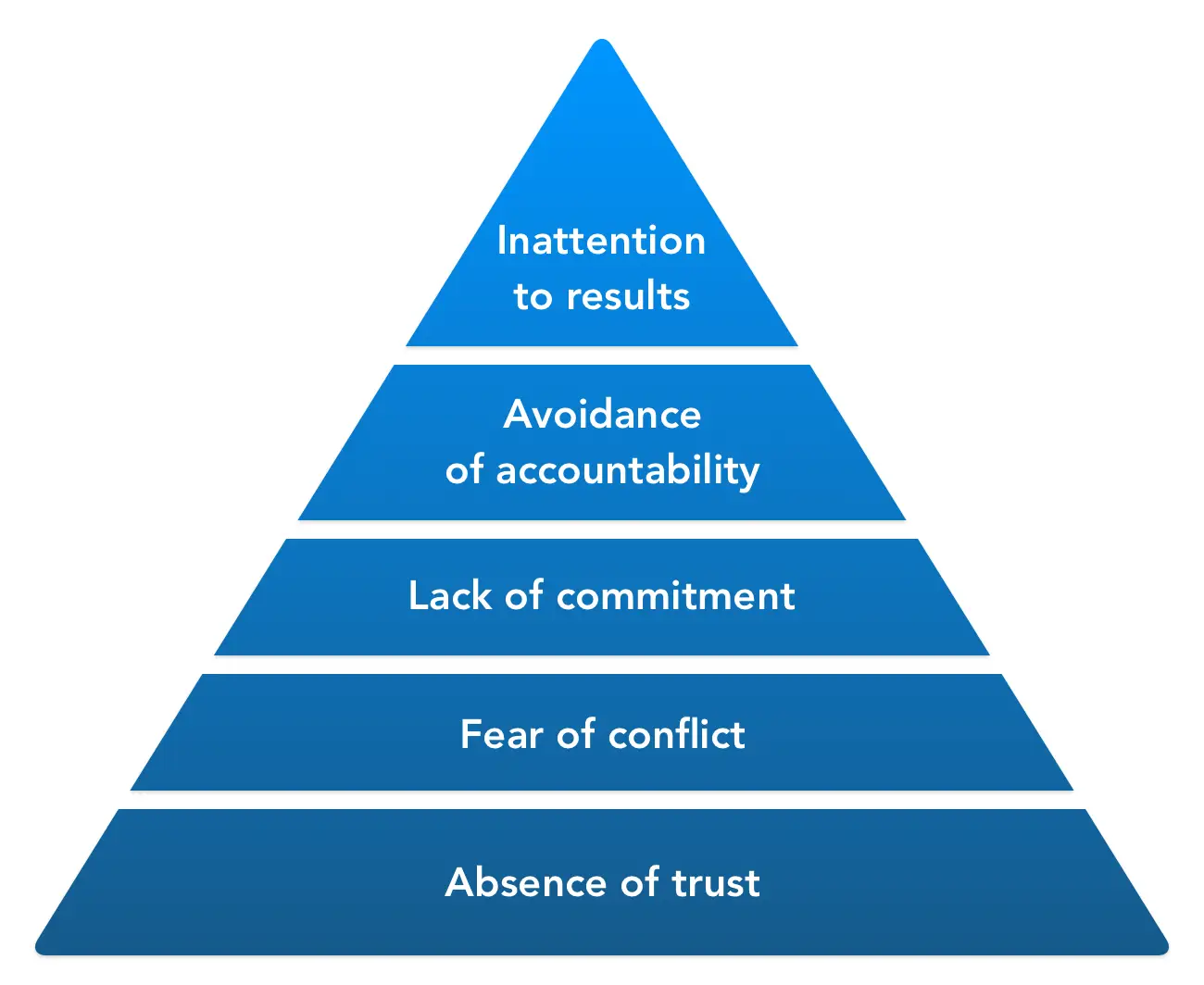
Patrick Lencioni published The Five Dysfunctions of a Team in 2002 as a business fable exploring the fundamental causes of organizational politics and team failure. Two decades later, his pyramid — trust, conflict, commitment, accountability, results — is more relevant than I expected it to be, especially having built and scaled teams through it in real time.
The foundation, absence of trust, has not changed. Without trust, team members hesitate to be vulnerable, share information, or seek help from one another. What has changed is the delivery mechanism: hybrid and remote teams make trust harder to build because the informal moments that used to create it — hallway conversations, shared meals — are gone. Leaders must engineer trust deliberately now instead of letting it happen organically.
Fear of conflict is the dysfunction I watch most closely. In high-growth, PE-backed environments, avoiding hard conversations is expensive. Teams that stay conflict-avoidant become fear-of-failure teams, second-guessing every decision — and in 2026’s compressed decision cycles, that hesitation is a competitive disadvantage, not just a culture problem.
Where I would push back on Lencioni: the model assumes stable, co-located teams working toward one shared outcome. Today’s teams are often distributed, cross-functional, and reshuffled quarterly. The pyramid still works, but leaders need to rebuild trust and commitment far more often than the original framework assumes.
The core insight remains true: dysfunction cascades from the bottom up, and so does the fix.